Mining Terms Glossary
Welcome to the Mineral and precious stone glossary
A B C D E F G H I J K L M N O P Q R S T U V W X Y Z All terms
N
Native
Composed of only a single element; not combined with any other elements.
Native elements (group)
Group of minerals containing naturally occurring minerals with a molecular structure of only one element; examples are Copper, Sulfur, and Diamond. Also included in this group are metallic and semi-metallic alloys, which are minerals composed only of two or more metallic or semi-metallic elements of varying percentage; two examples are Iron-Nickel (Fe,Ni) and Allemontite (As,Sb). The minerals Gold and Platinum are considered native elements even though they are never 100% pure gold or platinum, containing indefinite traces of other elements, thereby causing them to be metallic alloys. The native elements may be divided into three groups: The metallic elements, The semi-metallic elements, and the non metallic elements.
Natural Glass
Igneous rocks that forms when rapid cooling of molten rock occurs. Natural glasses, such as Obsidian, are amorphous with a rounded shape, and usually contain conchoidal fractures.
Nesosilicates
Group of silicate minerals that contain only single, non-combining groups of tetrahedrons. For more information, see "All About the Silicates Group".
Neutron
Neutrally charged particle of an atom that resides in its nucleus.
Nitrates
Group of minerals that contain one or more metallic elements plus the nitrate radical (NO3). These minerals are all fragile and soft. With one exception, they are all soluble in water, and are therefore found only in arid regions, primarily in dry lake deposits. The nitrates are a small group, and are sometimes classified as a sub-category of the carbonate group.
Nitric acid
(HNO3) Corrosive acid used in the manufacture of explosives and fertilizers. It is a very destructive liquid and will destroy many minerals. See also hydrochloric acid and acid test.
Nodular
Spherical, in the shape of a small rounded lump.
Nodule
Aggregate consisting of a spherical lump, usually from groups of small crystals.
Nonbrittle
Not brittle, meaning not crumbling to a powder when crushed.
Nonmetal
Substance that does not exhibit the properties of a true metal.
Non-crystalline
Not containing any crystals (i.e. amorphous mineral or variety of mineral).
Non-metallic elements (subgroup)
The nonmetallic elements are minerals that belong in the native elements group and don't exhibit any metallic properties (except for Graphite, which has a metallic luster). They are light in weight and can be transparent.
Nuclei
Plural form of nucleus.
Nucleus
The center of an atom that contains the protons and neutrons.
Nugget
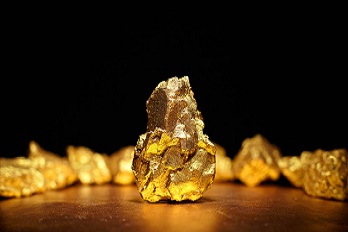
Compact, waterworn, amorphous mass, found in placer deposits.