MINING GLOSSARY
MINING GLOSSARY
A B C D E F G H I J K L M N O P Q R S T U V W X Y Z
C
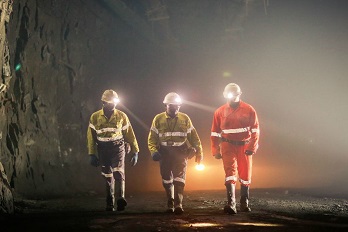
Cap Lamp - The lamp which a miner wears on his safety hat or cap. For illumination only.
Captive Mine - A mine which produces coal or mineral for use by the same company.
Cathode - The electrode where electrons enter (current leaves) an operating system, such as a battery, an electrolytic cell, an X-ray tube, or a vacuum tube. Opposite of anode.
Cinder Blocks - A block closing the front of a blast furnace and containing the cinder notch.
Coal - A solid, brittle, more or less distinctly stratified, combustible carbonaceous rock, formed by partial to complete decomposition of vegetation; varies in color from dark brown to black; not fusible without decomposition and very insoluble. The boundary line between peat and coal is hazy (see brown coal) as is the boundary line between coal and graphite and the boundary line between carbonaceous rock and coal. In the formation of coal, the vegetable matter appears to have been very largely moss and other low forms of plants, but in places, coal contains much wood; the vegetal matter seems to have first taken the form of peat, then lignite, and then bituminous coal. The latter by the loss of its bitumen has in some places been converted into anthracite (hard coal) and finally into graphite.
Coal Fields - An area of country, the underlying rocks of which contain workable coal seams.
Coal Gas - Flammable gas derived from coal either naturally in place, or by induced methods of industrial plants and underground gasification.
Coal Seam - A bed or stratum of coal.
Coal Tar - Tar obtained by the destructive distillation of bituminous coal, usually in coke ovens or in retorts and consisting of numerous constituents (as benzene, xylenes, naphthalene, pyridine, quinoline, phenol, cresols, light oil, and creosote) that may be obtained by distillation.
Coke - Bituminous coal from which the volatile constituents have been driven off by heat, so that the fixed carbon and the ash are fused together.
Coke Breeze - The fine screenings from crushed coke or from coke as taken from the ovens, of a size varied in local practice but usually passing a ½-inch or 3/4-inch screen opening.
Colliery - A whole coal mining plant, generally used in connection with anthracite mining but sometimes used to designate the mine, shops, and preparation plant of a bituminous operation.
Concentration - The process of increasing the dissolved solids per unit volume of solution, usually by evaporation of the liquid; the quantity of solute dissolved in a unit volume of solution.
Continuous Mining - Mining in which the continuous mining machine cuts or rips coal from the face and loads it onto conveyors or into shuttle cars in a continuous operation. Thus, the drilling and shooting operations are eliminated, along with the necessity for working several headings in order to have available a heading in which loading can be in progress at all times. The longwall machine and conveyor are in the same track which is situated between the last row of props and the face. The conveyor is moved forward progressively as the coal is cut and loaded by the machine. There are no separate or cyclic operations as in conventional machine mining and the aim is to make each shift a continuation of the previous shift. Where the conditions are favorable, faces up to 250 yards in length may be so worked.
Conventional Mining - The cycle of operations which includes cutting the coal, drilling the shot holes, charging and shooting the holes, loading the broken coal, and installing roof support. Also known as cyclic mining.
Conveyor - A mechanical contrivance generally electrically driven, which extends from a receiving point to a discharge point and conveys, transports, or transfers material between those points.
Core Drill - A drilling machine equipped with a hollow bit (core bit) and a core barrel which by rotation cuts out and recovers a rock core sample. A drill that removes a cylindrical core from the drill hole.
Cropline - A line following the outcrop.
Crosscut - A small passageway driven at right angles to the main entry to connect it with a parallel entry or air course.
Crusher - A machine for crushing rock or other materials. Among the various types of crushers are the ball-mill, gyratory crusher, Hadsel mill, hammer mill, jaw crusher, rod mill, rolls, stamp mill, and tube mill.
Crushing - Reducing ore or quartz by stamps, crushers, or rolls.
Crystallization - The formation of mineral crystals during the cooling of a magma or by precipitation from a solution.
Cut - In development work, the term cut refers to the location and direction of holes blasted first to provide a free face to which other holes may break. For example, draw cut, horizontal cut, pyramid cut, burned cut, etc.
Cutting Machine - A power-driven machine used to undercut or shear the coal to facilitate its removal from the face.