MINING GLOSSARY
MINING GLOSSARY
A B C D E F G H I J K L M N O P Q R S T U V W X Y Z
M
Man Car - A kind of car for transporting miners up and down the steeply inclined shafts of some mines, as at Lake Superior.
Man Trip - A trip made by mine cars and locomotives to take men rather than coal, to and from the working places.
Marsh Gas - Methane gas. If the decaying matter at the bottom of a marsh or pond is stirred, bubbles of methane rise to the surface, thus the name marsh gas.
Methane - Formed by the decomposition of organic matter, it is the most common gas found in coal mines. It is a tasteless, colorless, nonpoisonous, and odorless gas; in mines the presence of impurities may give it a peculiar smell.
Methane Monitor - A system whereby the methane content of the mine air is indicated automatically at all times, and when the content reaches a predetermined concentration the electric power is cut off automatically from each machine in the affected area. The mechanism is so devised that its setting cannot be altered. The system is used, mainly, in conjunction with the operation of continuous miners and power loaders.
Metric Ton - A unit of mass and weight that equals 1,000 kilograms or 2,204.6 avoirdupois pounds; abbreviation, MT.
Middlings - That part of the product of a washery, concentration, or preparation plant which is neither clean coal nor mineral nor reject (tailings). It consists of fragments of coal and shale or mineral and gangue. The material is often sent back for crushing and retreatment.
Mine Car - Cars which are loaded at production points and hauled to the pit bottom or surface in a train by locomotives or other power. They vary in capacity from 1 to 12 tons, and are either of wood or steel construction or combinations of both.
Mine Foreman - The person charged with the responsibility of the general supervision of the underground workings of a mine and the persons employed therein. In certain states, the mine foreman is designated as the mine manager.
Mine Inspector - One who checks mines to determine the safety condition of working areas, equipment, ventilation, and electricity, and to detect fire and dust hazards.
Miner - One who mines; as (1) one engaged in the business or occupation of getting ore, coal, precious substances, or other natural substances out of the earth; (2) a machine for automatic mining (as of coal); and (3) a worker on the construction of underground tunnels and shafts (as for roads, railways, waterways).
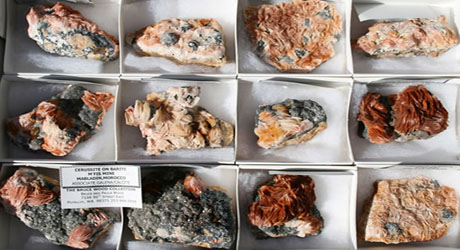
Mineral - In a broad nontechnical sense, the term embraces all inorganic and organic substances that are extracted from the earth for use by man. A substance occurring in nature which has a definite or characteristic range of chemical composition, and distinctive physical properties or molecular structure. With few exceptions, such as opal and mercury, minerals are crystalline solids.
Mineral Rights - The ownership of the minerals under a given surface, with the right to enter thereon, mine, and remove them. It may be separated from the surface ownership, but, if not so separated by distinct conveyance, the latter includes it.
Mine Run - The product of the mines before being sized and cleaned.
Mouth - An opening resembling or likened to a mouth, as one affording entrance or exit to a mine.
Muck - Unconsolidated soils, sand, clays, loams encountered in surface mining; generally, earth which can be severed and moved without preliminary blasting. Useless material; earth or rock which may or may not be mixed with coal or minerals.
Multiple-Seam Mining - Mining two or more seams of coal, frequently close together, that can be mined profitably where mining one alone would not be profitable.