







Glossary of Mining Terms

A reference table for basic element data, with related information on average crustal abundances, isotopes, water quality standards, common minerals and more.  
                                           

Posts Tagged ‘Open cut mining’

How is opal mined?

Wednesday, April 29th, 2009

Opal:

Opal has been a mystery for centuries. No two opals look alike. The word ‘opal’ was derived from a Greek word opallos, meaning “to see changes of color”. Opal is derived as a precious gemstone which is formed from non-crystalline silica gel. It consists of 6 to 10 per cent water and small silica spheres are arranged in a regular pattern. It generally measures 5.5 to 6.5 on MOH’s hardness scale with diamonds measuring 9 to 10 and pearls 4 to 5. It is a birthstone for October.

Opal dates back to 1849 where it was found at a cattle station named Tarrawilla, near Angaston some 80 km outside Adelaide in Australia. Nearly 95% of the opal is found in Australia. A small number is found in other countries like Mexico, Brazil and USA. There are three major opal mining regions in Australia that produce different types of opal.

White opal also known as “milk” opal is found in and around the towns of Coober Pedy, Mintabie and Andamooka in South Australia. The most famous opal is the black opal which is found in Lightning Ridge in the state of New South Wales. Boulder Opal is found in Central Queensland, Quilpie, Winton and Opalton. Other opals include Light Opal, Doublet, Triplet, Common, Synthetic and Imitation.

Most of the opal deposits are found in New South Wales, South Australia and Queensland. At present, mining of opal is done in the following areas and each produces solid Opal with specific characteristics and color patterns.

Lightning Ridge, NSW, is famous for glorious black opal. This town is situated 770 kilometers northwest of Sydney. Black opal was first discovered at Lighting Ridge in the late 1880’s.

White Cliffs is Australia’s oldest commercial opal field. This is situated around 295 kilometres northeast of Broken Hill. Opal was first mined at White Cliffs about 1889. For nearly 30 years, White Cliff opal fields produced opal for the world market.

The real development of Queensland’s vast opal deposits began in 1873 with the discovery of fine quality opal north of Thargomindah. Opal mines are concentrated in certain regions like Yowah, Quilpie, Eromanga and Jundah.

Coober Pedy is famous for White or milky opals. At present, opal fields encompass an area of approximately 45 kilometres. Andamooka is found southwest of Coober Pedy in harsh desert country. Andamooka is one of Australia’s most famous opal fields, having produced some of the most beautiful pieces of opal. The opal fields in and around Andamooka produce top gem, crystal, light opal and some dark opal.

Opal usually occurs in both sedimentary and volcanic rocks. There are various methods of opal mining.

Methods of opal mining

Sink a shaft:
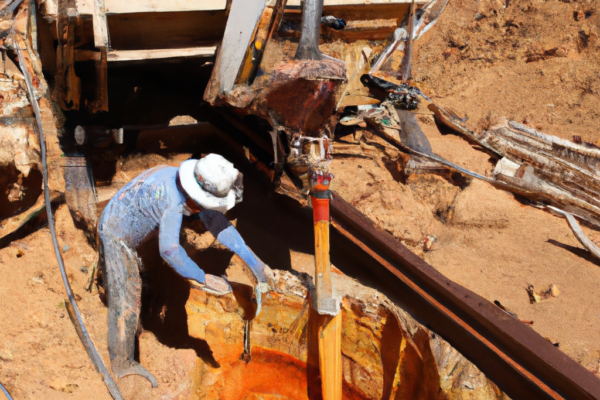
The simplest form of opal mining is by shaft sinking with a pick and shovel. A shaft is sunk straight down until some promising “opal dirt” is discovered. Length of the shaft could be as short as three metres or as long as 20 metres. A handpick or screwdriver is used to extract any opal found, due to the frailty of the stone.

Open cut mining:
Open cut method is done by the use of heavy machinery to remove large amounts of opal dirt from closer to the surface for inspection. This method is more expensive and is mostly used to search for boulder opal in Central Queensland.

Noodling:
Many locals search through heaps of discarded mullock for pieces of precious opal. An abandoned open-cut mine is another good place for a noodler, using a rake and sieve for tools. Some have taken to large scale machine noodling by allowing large amounts of opal dirt travel on a conveyer belt under ultra-violet light, which detects the precious opal.

Puddling and Rumbling:
A Puddler is a large mesh-lined drum attached to a motor. This device rotates and turns the clay into sludge as water is pumped into the drum. The sludge escapes through the mesh. A related technique is dry rumbling.

What is gold mining?

Tuesday, February 17th, 2009

Gold mining consists of the processes and techniques employed in the removal of gold from the ground. Earlier gold was mined using different methods like Panning, cradling, dry blowing, shaft mining, Puddling and dredging. Nowadays open cut mining and underground methods are used for gold mining.

Panning is one of the oldest techniques of separating gold from rock. Gold panning technique was introduced by Isaac Humphrey at Coloma in 1848. Also Mexicans developed panning technique in their country, using a flat dish called a batea. Gold panning was slow even for most skillful miner. In a single day, one miner was able to wash only 50 pans in 12 hour workday and obtain only a small amount of gold dust. This method was the most common method of mining on the goldfields. Rocky material was loosened with pick and shovel. After it had been broken down, this rocky material was taken by wheelbarrow to a creek where it was carefully washed and swished around a shallow metal pan. As the water separated the particles of dirt, rock and pebbles, small deposits of gold sank to the bottom of the pan. This was successful for yielding small nuggets. A persistent prospector could find a considerable amount of gold over time.

Cradle (Rocker): This method was introduced by Isaac Humphrey. Cradling involves a wooden box with a handle on one side and a ridged bottom covered with Hessian cloth. Large pieces of rock were sorted through and discarded if they did not yield any gold. Finer rocks and pebbles were then washed with creek water across the ridges in the bottom of the cradle. This method was more successful then panning in that it meant that greater amounts of gravel and dirt could be examined.

Dry blowing: This method was not very effective. This method was adopted in some parts of Australia like Kalgoorli in Western Australia. In this method two pans were used. Fine, dust like material was poured from a pan held high, into the second pan which was positioned on the ground. As the material was poured down, the wind blew away the dust and fine particles of rock, while the tiny nuggets of gold fell into the pan below. While the method was sound in theory, the winds meant that tiny particles of gold could be blown away with the rest of the dust and dirt.

Shaft mining:
One of the popular methods was shaft mining. To find gold from underground, miners dug a shaft of up to 50 meters deep. Most of the miners were equipped for pick and shovel, so this was considered a long and tiring task. This method was adopted when prospector was confident that there was gold in a particular place. It was very difficult to find gold in older days, because there was no proper mining equipment. Discovering gold was more a matter of luck than good judgment.

Puddling:
This method was used to separate gold from clay. Small amounts of clay were dumped in a large container and were filled with water. As it was stirred with wooden stake, clay would dissolve and gold particles would sink to the bottom. Like other methods, even this method did not yield huge amounts of gold, but they were able to get a reasonable amount of gold.

Dredging:
In this method, a huge bucket would be placed in front of the dredge which would scoop vast amounts of sediment from the river bed. This method would then be carefully sifted and sorted. After the sifting was completed, waste material was returned to river bed.

Open cut mining:
In this method, rocks that are on surface are removed and moved to another place. Over a period of time, the mine is excavated in a series of layers, known as benches. Mining company does take safety measures at regular intervals within the mine to reduce the risk of rock falls. Benches allow trucks and other large vehicles to enter the site and allow drilling and ore sampling at different levels. The rocks that are removed with the help of machines are crushed and sifted through for gold. This method is very profitable because the removed rocks will at least have three to four grams of gold per tonne.
Drills and explosives are used to break the rock. Explosives like ammonium nitrate are used to break the rock. It causes less damage to nearby areas.

Underground Mining:
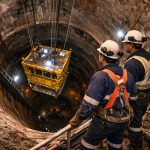
In underground mining, gold is found below the surface. This method is very costly and cause dangers to mine workers. In this method, a shaft is sunk into the ground which would be 1000 meters deep. Horizontal tunnels, known as stopes are dug at various depths and the miners work along these to access the gold.

Vehicles gain access to the various levels of the mine through a spiral tunnel known as a decline. As mineshafts become deeper, the risk of cave-ins or collapses increases. Underground mines operate under strict safety protocols. These include the way the mineshafts are dug and constructed, the methods of support for the walls and ceiling of the mine and the use of special machines to provide adequate ventilation and lighting


HOME    ABOUT US    RESOURCES    FAQ's    CONTACT US    SITEMAP    ENGAGEMENT RINGS
Copyright © 2003 YourCompany Inc. All rights reserved.