





Glossary of Mining Terms

A reference table for basic element data, with related information on average crustal abundances, isotopes, water quality standards, common minerals and more.  
                                           

Posts Tagged ‘Surface Mining’

How the Ancient People Initiate the Mining Techniques

Tuesday, April 20th, 2010

The process of mining the earth and finding the metals, minerals, etc and again making the earth to return back to its original state consists of different steps. Generally, mining techniques can be broadly classified into two types, they are Surface Mining and Underground Mining.

In pre-historic period, when the people had found metals like copper, iron on or close to earth surface, they used to manufacture some tools and weapons.

The ancient known mine is the “Lion Cave” which is in Swaziland. Ancient people used hammers, crude picks, etc. But they found very difficult to find the metals or any other precious stones which was in too deep. So they slowly started to invent new ideas to make the work simple. Since there is no blasting method available in that period, they first used to keep fire on the hard rocks to make it soft then they used water to cool it up and so they had broken those hard rocks easily.

The slaves, prisoners of war and the people who did criminal things had forced to work on the mining areas. And the kids were used to carry the ores from the underground mining area to the outer surface. Then the people who are so weak to work underground had made to separate the rich and poor metals.

In some countries they used “Black Powder” to disclose ore veins and earth to loosen. Then as the development occurs, the people have found a plenty of techniques to find the metals, minerals and other precious stones.

Some of the ancient mining techniques were,

  • Fire setting
  • Hydraulic mining
  • Reverse overshot water-wheels

Oil and gas extraction mining

Monday, June 15th, 2009

The oil and gas extraction segment produces the petroleum and natural gas that heat homes, fuel cars, and power factories. Petroleum products are also the raw materials for plastics, chemicals, medicines, fertilizers, and synthetic fibers. Petroleum, commonly called crude oil or just oil, is a liquid formed under ground from the decay of plants and animals over millions of years through extreme heat and pressure. Occasionally, this decaying material becomes trapped under a layer of impermeable rock that prevents it from dispersing and creates a pocket of oil. Similar processes also produce natural gas, which can be found mixed with oil or in separate deposits. Finding and extracting the oil and gas in these pockets is the primary function of this industry segment.

Using a variety of methods, on land and at sea, small crews of specialized workers search for geologic formations that are likely to contain pockets of oil or gas. Sophisticated equipment and advances in computer technology have increased the productivity of exploration. Maps of potential deposits now are made using remote-sensing satellites. Seismic prospecting—a technique based on measuring the time it takes sound waves to travel through underground formations and return to the surface—has revolutionized oil and gas exploration. Computers and advanced software analyze seismic data to provide three-dimensional models of subsurface rock formations. Another method of searching for oil and gas is based on collecting and analyzing core samples of rock, clay, and sand in the earth’s layers.

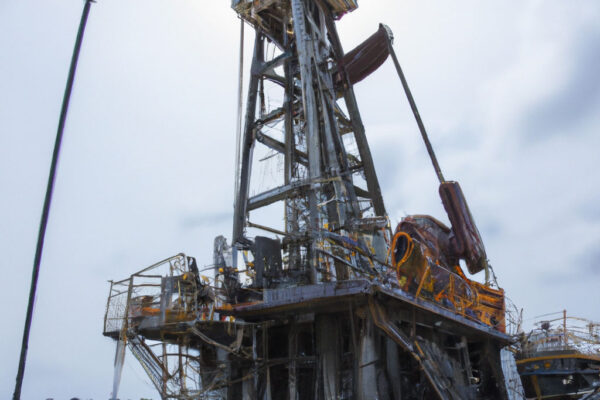
After scientific exploration studies indicate the possible presence of oil, a well must be drilled to prove oil is there. An oil company selects a well site and installs a derrick—a tower-like steel structure—to support the drilling equipment. A hole is drilled deep into the earth until oil or gas is found, or the company abandons the effort. Similar techniques are employed in offshore drilling, except that the drilling equipment is part of a steel platform that either sits on the ocean floor, or floats on the surface and is anchored to the ocean floor. Advancements in directional or horizontal drilling techniques, which allow increased access to potential reserves, have had a significant impact on drilling capabilities. Drilling begins vertically, but the drill bit can be turned so that drilling can continue at an angle of up to 90 degrees. This technique extends the drill’s reach, enabling it to reach separate pockets of oil or gas. Because constructing new platforms is costly, this technique commonly is employed by offshore drilling operations.

Once the drilling reaches the oil or gas, extraction can begin as natural pressure forces the oil or gas up through the drill hole to the wellhead, where it enters separation and storage tanks. If natural pressure is not great enough to force the oil to the surface, pumps may be used. In some cases, water, steam, or gas may be injected into the oil deposit to improve recovery. The recovered oil is transported to refineries by pipeline, ship, barge, truck, or railroad. Natural gas usually is transported to processing plants by pipeline. While oil refineries may be many thousands of miles away from the producing fields, gas processing plants typically are near the fields, so that impurities—water, sulfur, and natural gas liquids—can be removed before the gas is piped to customers. The oil refining industry is considered a separate industry, and its activities are not covered here, even though many oil companies both extract and refine oil.

Coal mining industry

Monday, May 18th, 2009

The coal mining industry segment produces coal, a fossil fuel that is used primarily for electric power generation and in the production of steel. Like oil, coal is formed over millions of years from plant and animal matter, but unlike oil, coal is a solid, and therefore miners must go into the earth to recover it. Many coal seams are located close to the surface, however, which makes the extraction of this resource easier.

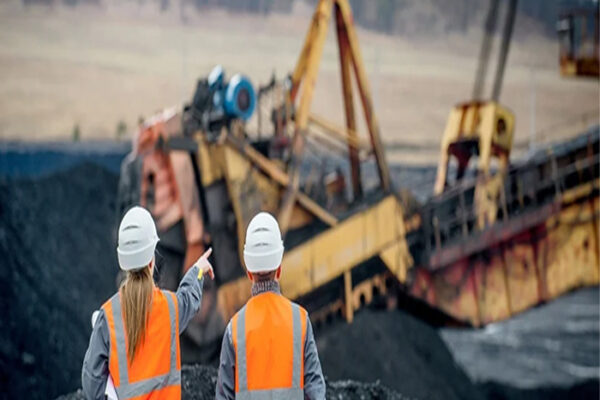
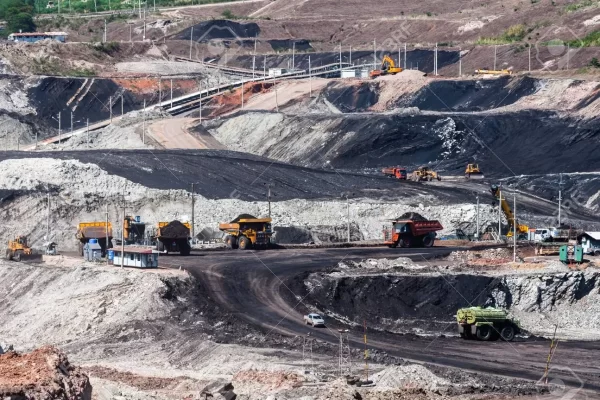
Surface mining of coal typically uses the method known as strip mining, which is usually more cost-effective than underground mining and requires fewer workers to produce the same quantity of coal. In strip mining, workers use huge earthmoving equipment, such as power shovels or draglines, to scoop off the layers of soil and rock covering the coal seam. Once the coal is exposed, it is broken up by using explosives, and then smaller shovels lift it from the ground and load it into trucks. Mining companies are required by Federal, State, and local laws to restore the mined land after surface mining is completed; as a result, the overburden and topsoil are stored after removal so that they can be replaced and native vegetation replanted.

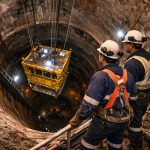
Underground mining is used when the coal deposit lies deep below the surface of the earth. When developing an underground mine, miners first must dig tunnels deep into the earth near the place where the coal is located. Depending on where the coal seam is in relation to the surface, tunnels may be vertical, horizontal, or sloping. Entries are constructed so that miners can get themselves and their equipment to the ore and carry it out, while allowing fresh air to enter the mine. Once dug to the proper depth, a mine’s tunnels interconnect with a network of passageways going in many directions. Using the room-and-pillar method, miners remove sections of the coal as they work the coal seam from the tunnel entrance to the edge of the mine property, leaving columns of coal in place to help support the ceiling together with long steel bolts. This process is then reversed, and the remainder of the ore is extracted, as the miners work their way back out. In the case of longwall mining of coal, self-advancing roof supports, made of hydraulic jacks and metal plates, cover the area being mined. As coal is removed, the entire apparatus advances, allowing the ceiling in the mined area to cave in as the miners work back towards the tunnel entrance. Underground mining does not require as extensive a reclamation process as surface mining; however, mine operators and environmental engineers still must ensure that ground water remains uncontaminated and that abandoned mines do not collapse.

Various types of Mining Equipments

Thursday, January 22nd, 2009

The mining industryis one of the most dangerous working environments. Mining equipments are instruments that are commonly used in extraction of minerals from the earth surface. In the past, ancient times, miners used to excavate minerals and metals by using simple hand held tools. With the introduction of automation and modernization, today’s mining world enjoys the benefit of many types of mining equipments that are used specially for mining purposes. Modern day mining equipment is powered mainly by electricity and hydraulic energy.

Mining equipments are available for various types of mining methods that are performed around the world. There are various types of mining equipments available in the world. Some of them are industrial shredders, drilling equipment, blasting equipment, drill rigs, hammers, mine winders, blasting machine, Mining Locomotive, well drilling machine, industrial crushers, cutting machines, drills, loaders, blasting devices, Track Drill, Rock Drill, etc. Some examples of mining equipment that is used extensively in mining operations are: hard hats, clothing/gear, ventilation fans, rock dusters, tractors, earth movers, water jet pumps, cutting machines, drills, loaders, blasting devices, dozers, trucks, cranes, fork lifts, draglines and many other machineries. A mining light system is important mining equipment used for all mining processes. A mining light system increases the efficiency and the speed of mining operations and guarantees optimum results in mining process. A mining light might consist of a heat sink, LED or laser, magnetic switch or a focusing cone. Gold pans, sluice boxes, metal detectors, digging tools, gold vials, snuffer bottles, etc., are equipments used for gold mining. Various kinds of large mining excavators are available for mining field. The mining excavators using advanced technology help in reaching the international level of performance in mining processes.

There are mining equipments available specifically for Surface mining processes such as open-pit mining, strip or area mining, quarrying, contour mining, mountaintop removal, and placer mining. For example, some of the Open Cast Mining Equipments are Rock Drills, Drifter, Paving Breaker, DTH Hammer, Wagon Drill, Slim Drill LD-4, Pneumatic Crawler Drill, TCT Drill Steel Grinder, and Cross Bit Grinder. There are excellent mining equipments available for Sub-surface mining processes such as shaft mining, drift mining, borehole mining, slope mining, and hard rock mining. Similarly, there are special mining equipments for deep underground mining processes such as Longwall mining, Continuous mining, Blast mining, Shortwall mining and Retreat mining. For example, some of the underground Mining Equipments are Junior Simba, Mucking Machine, Slurry Pump, Exhaust Fan, Air Mover, Cement Injection Pump, Pneumatic Power Pack, Turbo Light, Spare parts for Atlas Copco Drifter BBC-120F, Simba Junior, BMS-46 Feed Motor, BSP 10 Pneumatic Rod Catcher, Atlas Copco Cavo 310 Loader, Pneumatic Raise Climber, Eimco Loader & Hopper.

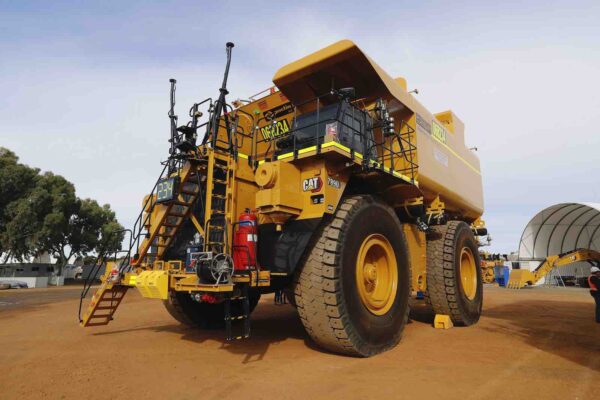
The use of right mining equipment is very essential for increased productivity. For example, the use of large mining equipment in surface mining maximizes the recovery through the excavation of one or more coal seam deposits in the large area surface mines.

Many features, restrictions and criteria need to be considered while choosing the mining equipments for a mining process. The two most important factors for choosing any type of mining equipment are its strength and durability. Cost is also an important consideration while selecting mining equipments.

Mining is a very dangerous process. If a wrong piece of equipment or tool is used for a specific mining purpose, it might lead to disaster. Therefore it is important that everybody involved in the mining operation must know exactly how to use their mining tools properly. Each worker should be properly and thoroughly trained to use every part of mining equipment they will be using. Also the workers should be educated about the safety measures in using the mining equipments.

Development in Mining Technology

Tuesday, October 21st, 2008

The development of mining technology plays an important role in the mining industry as well as in the environment. The mining industry plays a crucial role in our economy. The mining industry was very conservative in initiating and adopting new technologies in the past due to high capital requirements, environmental limitations and small profit margins. However, the mining industry has made significant progress in productivity, mining technologies used, environmental control, and worker health and safety. The mining industry has also introduced improved clean technology to carry out best mining processes and practices. Such practices have been applied in developing countries which achieved best results. When mining technologies become more widely available, there will be only technology gap between mining industries and countries.

The mining industries continue to play their essential role in sustainable technological development to improve their performance, reduce environmental pollution to all media and enhance the quality of life within their operational work area. The mining industry aims at adopting and implementing innovative technologies through the usage of both mining and environmental technologies to create a better environment quality in mining industry areas, reduce negative impact to human health and environment, reduce water and air pollution, and land degradation.

Most of the recent developments made in mining technologies prove to be cost-effective and environment-friendly technologies. For example, Solvent-extraction/electro-winning (SXEW) is a hydrometallurgical process that differs from the traditional method of producing copper by milling, smelting, and refining. The development of the SXEW process helps in the low-cost production of copper from waste and raw ore dumps of copper minerals excavated from copper mines. SXEW helps United States and few other copper-producing countries very much. EESTECH provides environmentally sustainable technologies that have direct application in the world’s coal mining and energy industries. EESTECH’s Hybrid Coalmine Gas Technology (HCGT) is a recognized Clean Development Mechanism (CDM) that uses waste coal and ventilated coalmine methane as a fuel source to produce cost effective clean coal energy. Clean coal technology offer solutions in the fight against global warming.
The development of new mining technologies helps to reduce production costs, enhance the quality of mined metals and minerals , enhance the quality of commodities using mined minerals, reduce adverse environmental effects, health and safety impacts. Thus the mining technological developments benefits consumers and producers, as well as nation’s economy, national defense, health and social well being.

The most developed and developing countries have already imposed environmental standards for emission, effluent, groundwater contamination, and hazard and toxic management guidelines. But because of weak law enforcement, lack of monitoring capability and skilled human resources, the mining industry do not obey. Hence, the environment standards must be harmonized within the developing countries in order to improve the environmental performance and management of mining industries.

Political and social institutions could exert enormous influence over the mining industry development. Political Institutions including central government, local government and public decision makers must creating international harmonization of environmental standards for better positioning for global competitiveness in mining product. Doing so will improve the corporate image of the mining industries as well as benefit the global consumers.

Workshops and training programs on pollution control and measurement techniques of mining activities, and development of network among mining partnership organizations should be carried out through internship and technical assistance in mining industries.


HOME    ABOUT US    RESOURCES    FAQ's    CONTACT US    SITEMAP    ENGAGEMENT RINGS
Copyright © 2003 YourCompany Inc. All rights reserved.