



Glossary of Mining Terms

A reference table for basic element data, with related information on average crustal abundances, isotopes, water quality standards, common minerals and more.  
                                           

Posts Tagged ‘Uranium Mining’

How the Ancient People Initiate the Mining Techniques

Tuesday, April 20th, 2010

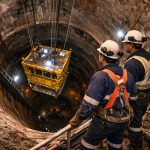
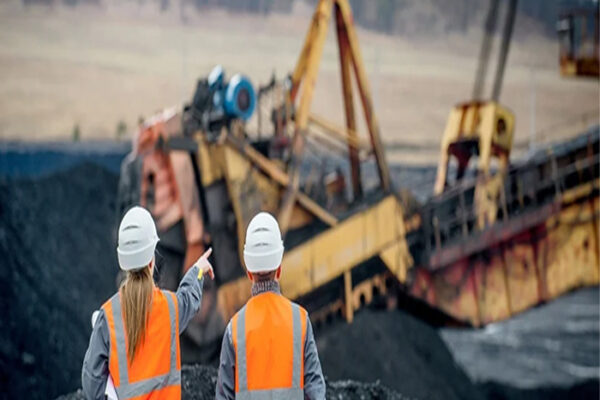
The process of mining the earth and finding the metals, minerals, etc and again making the earth to return back to its original state consists of different steps. Generally, mining techniques can be broadly classified into two types, they are Surface Mining and Underground Mining.

In pre-historic period, when the people had found metals like copper, iron on or close to earth surface, they used to manufacture some tools and weapons.

The ancient known mine is the “Lion Cave” which is in Swaziland. Ancient people used hammers, crude picks, etc. But they found very difficult to find the metals or any other precious stones which was in too deep. So they slowly started to invent new ideas to make the work simple. Since there is no blasting method available in that period, they first used to keep fire on the hard rocks to make it soft then they used water to cool it up and so they had broken those hard rocks easily.

The slaves, prisoners of war and the people who did criminal things had forced to work on the mining areas. And the kids were used to carry the ores from the underground mining area to the outer surface. Then the people who are so weak to work underground had made to separate the rich and poor metals.

In some countries they used “Black Powder” to disclose ore veins and earth to loosen. Then as the development occurs, the people have found a plenty of techniques to find the metals, minerals and other precious stones.

Some of the ancient mining techniques were,

  • Fire setting
  • Hydraulic mining
  • Reverse overshot water-wheels

Problems of Uranium Mining

Thursday, December 11th, 2008

Tailings squander
Even the utmost grade deposits have less than 1% uranium. So vast amounts of ore have to be processed to obtain useful quantities of the uranium. The leftover ‘waste’ rock is known tailings. In the course of processing it is crushed to a well powder, which is nearly as radioactive as the uranium itself. It is perilous for more than 250,000 years, which might as well be eternally. These tailings need to be secluded from the environment to avoid a cancer epidemic, and there are previously more than 50 million tonnes of uranium tailings on Australian soil.

Radon Gas
As uranium emanates radiation; it transforms itself into a novel element, which in turn emanates radiation and decays, and so on through 14 steps until it ultimately - after hundreds of thousands of years - becomes a stable type of non-radioactive lead. One of the elements along the way is radon, a radioactive gas which can travel for hundreds of kilometres prior to decaying. Mine workers and others who breathe in this gas risk mounting lung cancer and other kinds of lung disease

Environmental Pollution
Uranium mining pollutes the air, water and earth with radioactive chemicals and heavy metals which can never be well cleaned up. In addition to the radiation hazard, mining is also related with poisonous process chemicals, heavy metals and the use of vast quantities of water. In the short term, uranium mine sites ruin the ecology of the local region; in the long term, they pose a risk to a much wider area.

Health risks
The health risks of uranium mining are by now fairly well known, although still belligerently disputed by the mining industry. Collectively, uranium miners suffer the maximum radiation doses of all workers in the nuclear fuel chain. The major problems are inhalation of dust and radon gas, which leave alpha radiation emitters lodged in the body where they can do the majority harm. As the pollution from the mines spread away from the minesite, local people are also out in the open to contamination. While uranium mining is most usually allied with cancer, low level radiation is also mixed up in birth fault, high infant mortality and chronic lung, eye, skin and reproductive illnesses.

Nuclear Waste
There is a vast amount of high level nuclear waste still being spewed out by reactors round the world and there is nowhere safe to put it. Pangea Resources actually has a plan to bring many of this waste into Australia. Nuclear power stations create this waste as fraction of normal operations; but there are also risks of reactor accidents; the explosion at Chernobyl in 1986 killed a lot of people, spread nuclear pollution right around the planet and forced the enduring evacuation of the surrounding area.

Nuclear Weapons
While the mining companies do not like to confess it, nuclear power is a military technology designed to make plutonium for nuclear weapons. Thousands of these weapons are still on hairtrigger alert ten further than ten years after the Cold War, and they are spreading gradually to new countries.


HOME    ABOUT US    RESOURCES    FAQ's    CONTACT US    SITEMAP    ENGAGEMENT RINGS
Copyright © 2003 YourCompany Inc. All rights reserved.