






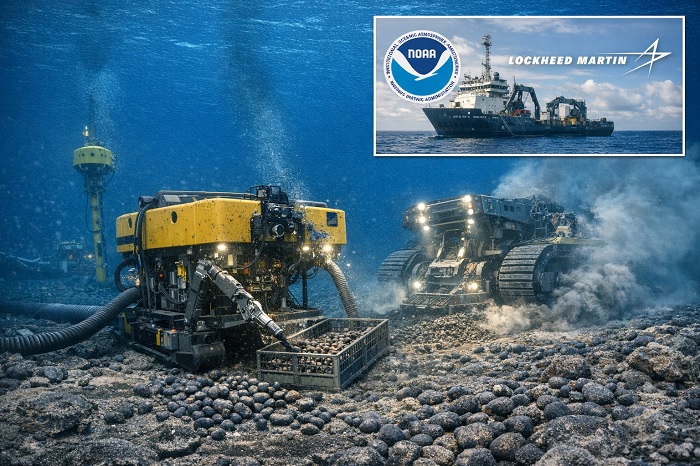
Deep seabed mining focuses on recovering critical minerals from the ocean floor. These resources—such as manganese, nickel, cobalt, copper, and rare earth elements—are essential for many modern technologies, including defense systems, batteries, smartphones, and medical devices. Because these minerals are used across so many industries, securing steady access to them is increasingly seen as an important step in strengthening and stabilizing U.S. supply chains.
Before any U.S. citizen or U.S.-based company can begin deep seabed mining activities in ocean areas outside U.S. national jurisdiction, they must obtain government authorization. Under the Deep Seabed Hard Mineral Resources Act (DSHMRA), NOAA is responsible for issuing exploration licenses and commercial recovery permits. Exploration licenses allow companies to conduct surveys, research, and test mining, while commercial recovery permits authorize full-scale recovery of polymetallic nodules—often rich in manganese, nickel, cobalt, and copper—for commercial purposes.
For mining activities taking place within U.S. waters, the primary legal framework is the Outer Continental Shelf Lands Act. This law is administered by the Department of the Interior’s Bureau of Ocean Energy Management, which oversees offshore mineral activities within national jurisdiction.
In international waters, deep seabed mining is regulated by the International Seabed Authority (ISA) for nations that are parties to the Law of the Sea Convention (LOSC). Since the United States is not a party to the LOSC, it relies on DSHMRA instead. This means the U.S. can still issue exploration licenses and commercial recovery permits to U.S. companies operating beyond national jurisdiction, provided they meet all legal and regulatory requirements under DSHMRA.
On April 24, 2025, the President signed Executive Order 14285, which introduced policies aimed at boosting U.S. leadership in seabed mineral exploration and supporting responsible commercial recovery. This order aligns with broader efforts to improve access to critical minerals and reduce supply chain vulnerability.
For companies applying for DSHMRA exploration licenses or commercial recovery permits, NOAA’s National Ocean Service manages the review and processing of applications, while final approval is granted by the NOAA Administrator. NOAA aims to review applications efficiently, but applicants must follow several required steps, and certain stages include public comment periods. These public comment opportunities are announced through the Federal Register.
On January 21, 2026, NOAA issued a final rule titled “Deep Seabed Mining: Revisions to Regulations for Exploration License and Commercial Recovery Permit Applications.” This rule updates parts of the DSHMRA regulations related to how exploration and commercial recovery applications are reviewed. NOAA accepted public comments on the proposed version of the rule from July 7, 2025 through September 5, 2025, including submissions through the Federal e-Rulemaking Portal and feedback gathered during two virtual public hearings.
At present, Lockheed Martin Corporation holds two DSHMRA exploration licenses—USA-1 and USA-4—originally issued in 1984. Currently, there are no commercial recovery permits issued under DSHMRA.
Beyond permits and licenses, NOAA also supports seabed mineral efforts through seafloor mapping. While this mapping primarily helps with nautical charts, coastal planning, and habitat studies, it can also be useful for identifying potential critical mineral deposits.
In January 2026, the National Ocean Service’s Office of Coast Survey announced a hydrographic survey project covering more than 30,000 square nautical miles of federal waters near American Samoa. The baseline data collected from this effort will help other federal agencies better understand potential mineral deposits and the overall prospectivity of the area. This project supports the Department of Commerce’s U.S. Offshore Critical Minerals Mapping Plan under Executive Order 14285.