




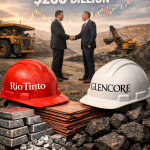
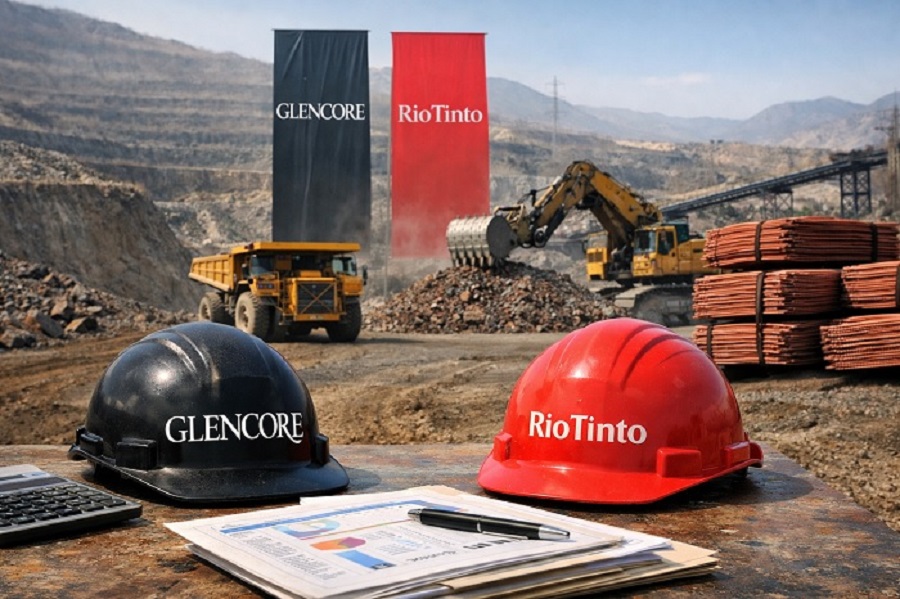
Swiss mining giant Glencore has signaled that it remains open to pursuing major acquisitions, even after its massive $260 billion merger discussions with Rio Tinto recently fell apart.
Speaking publicly for the first time since the collapse of the talks, CEO Gary Nagle said the company is still interested in large-scale consolidation deals. According to him, investors are supportive of efforts that could make Glencore a more influential and competitive player in the global mining industry.
Nagle emphasized that consolidation across the sector makes strategic sense, especially as demand for copper and other critical minerals continues to rise amid geopolitical tensions and the global energy transition. He noted that both he and many of the company’s shareholders believe the industry needs to become “more relevant,” and mergers are one way to achieve that goal.
The failed discussions with Rio Tinto reportedly broke down due to disagreements over valuation. Under UK takeover rules, both companies must observe a six-month cooling-off period before reopening formal talks, though this timeframe can sometimes be shortened. Despite the setback, Nagle’s comments leave the door open for renewed negotiations in the future — whether with Rio Tinto or another mining heavyweight.
The broader mining sector is already seeing consolidation activity. Rivals such as Anglo American and Teck Resources have agreed to combine in a friendly merger, reflecting a wider industry trend. In recent years, Glencore has also explored other major deals, including a failed takeover bid for Teck Resources in 2023 and earlier preliminary discussions with BHP in 2022.
Financially, Glencore reported mixed results for 2025. Operating earnings declined 6 percent compared with the previous year, mainly due to weaker coal prices. Adjusted earnings before interest, tax, depreciation, and amortisation (EBITDA) fell to $13.5 billion, down from $14.4 billion in 2024.
While strong performance in the copper division helped offset some of the pressure — supported by price volatility linked to shifting US tariff policies — it was not enough to fully counter the slump in coal. The company’s energy and steelmaking coal division saw a 30 percent drop in adjusted earnings as fuel prices softened.
Despite the earnings dip, Glencore announced a dividend of roughly $2 billion and confirmed it had finalized a land access agreement for its KCC copper mine in the Democratic Republic of Congo. Investors reacted positively, with shares climbing nearly 3 percent at the market open.
During discussions with journalists, Nagle reiterated that many of the company’s largest shareholders favor further dealmaking. He acknowledged that while some Australian investors at Rio Tinto had reservations during the merger talks, many London-based shareholders were more supportive.