






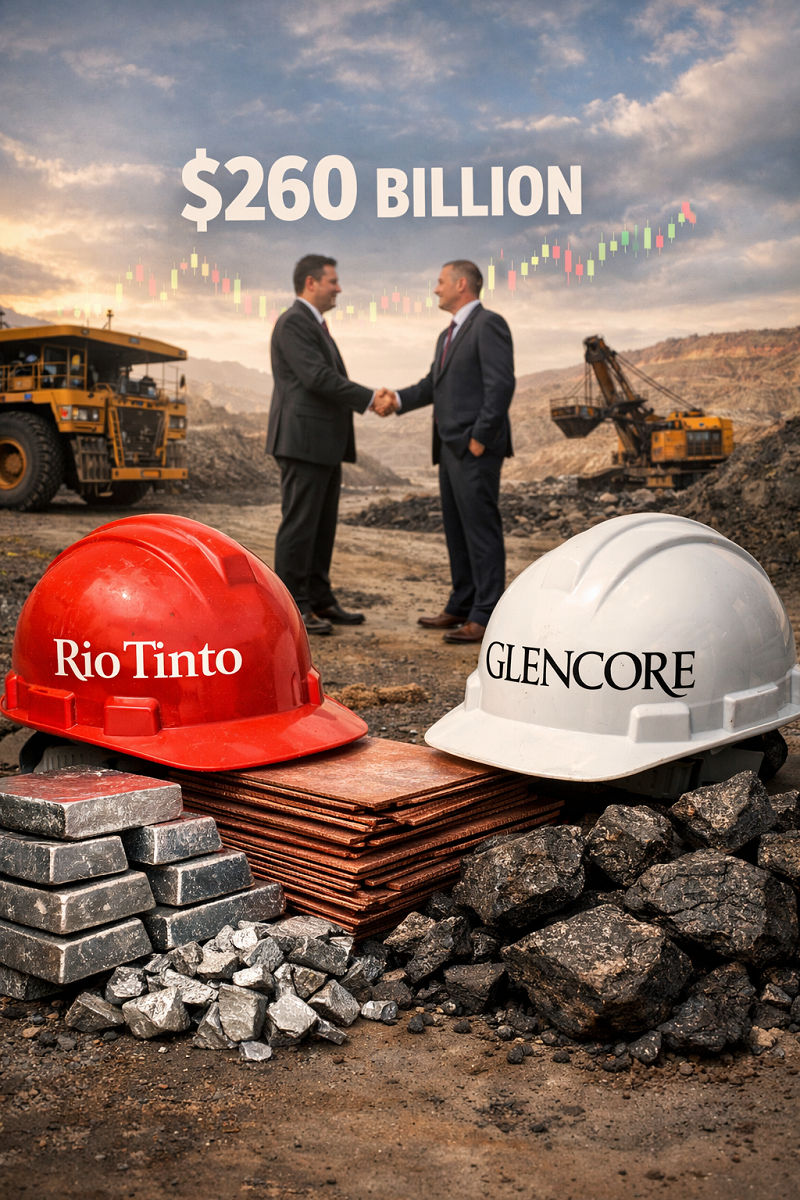
Rio Tinto and Glencore have resumed merger discussions that, if successful, would result in the creation of the world’s largest mining company. The renewed talks come nearly a year after earlier negotiations between the two mining giants fell apart due to disagreements over valuation, leadership, and asset structure.
If a deal is finalized, the combined entity would have an estimated enterprise value exceeding $260 billion, making it a dominant force in the global mining industry. Both companies confirmed that they are currently engaged in preliminary discussions regarding a possible combination of some or all of their businesses, which could involve an all-share merger. Rio Tinto, with an enterprise value of about $162 billion, indicated that the proposed structure could result in it acquiring Glencore.
Founded in 1873, Rio Tinto employs around 60,000 people across 35 countries and is one of the world’s most established mining companies. Glencore, originally founded in 1974 as a commodities trading firm, operates in more than 30 countries and has a workforce of approximately 150,000 employees and contractors, reflecting its vast global footprint.
According to Rio Tinto, the current expectation is that any transaction would be completed through a court-sanctioned scheme of arrangement, allowing Rio to acquire Glencore. However, the company emphasized that there is no certainty that a formal offer will be made or what the final terms might be.
The revival of these talks follows a broader trend of consolidation in the mining sector. This includes the $53 billion merger between Anglo American and Teck, which brought together two of the world’s largest copper producers. Previously, Anglo American rejected a takeover bid from BHP Group, while Teck declined a buyout offer from Glencore in 2023.
The renewed interest in mergers comes at a time when copper prices have reached record highs of more than $13,300 per tonne, driven by forecasts of a potential global supply shortfall of up to 10 million tonnes by 2040. Analysts say demand is being fueled by rapid growth in electric vehicles, AI data centers, and renewable energy infrastructure.
Industry experts note that consolidation within the natural resources sector is accelerating in early 2026. A full merger between Rio Tinto and Glencore would create a global leader in several key industrial and transition metals, including iron ore, copper, cobalt, and lithium—all of which are critical to modern technology, clean energy, and defense applications.
In December, Gary Nagle, CEO of Glencore, stated that the company’s ambition is to become the largest copper producer in the world. Currently, Glencore ranks as the sixth-largest copper producer globally and is also the largest listed coal producer, a point of strategic debate in the merger talks.
One of the major challenges in previous negotiations was the future of Glencore’s coal mining operations. In May, Glencore announced plans to separate its coal assets into a standalone, Australia-based entity. Rio Tinto, which exited coal mining in 2018, is reportedly open to retaining these assets, reflecting a broader shift in political and economic attitudes toward fossil fuels.
This shift has been influenced by changing global policies, including actions by Donald Trump to roll back green initiatives and withdraw the U.S. from key climate agreements, alongside renewed investment in traditional energy sources by major oil and gas companies.
Since the earlier talks ended, Rio Tinto has appointed a new chief executive, Simon Trott, who took over in August. Analysts believe the combined company’s diversified asset base could help stabilize earnings during commodity price swings, though questions remain about how Glencore’s coal and trading businesses would align with Rio’s sustainability goals.
Under UK takeover regulations, Rio Tinto must decide by 5 February whether to make a formal offer for Glencore or publicly withdraw from the process. Market reactions have been mixed, with Rio’s shares falling while Glencore’s stock surged on the news.
Historically, both companies have been deeply involved in major industry-shaping deals. Rio Tinto acquired Alcan in 2007 to become the world’s largest aluminium producer, while Glencore completed its landmark takeover of Xstrata in 2012, creating a vast commodities conglomerate. More recently, Newmont acquired Newcrest Mining, further underscoring the ongoing consolidation trend across the global mining industry.